
Energy is Everything
Wrapping up the oil and gas primer

This is the final post in a series on the oil and gas industry, for readers interested in climate change, policy, and regulation. Start with the first post to follow a hydrocarbon’s journey, from a seismic survey to the plastic in your phone case.
Eight posts ago, I promised that if you stuck around, you’d have a clear understanding of how the oil and gas industry works, from rock to refinery to end products, and where those who care about climate can find leverage points in the system.
This post has more editorial commentary than most, so please comment or write me if you think I’m off! I love talking to readers and reply personally to every message.
I’ll be moving on after this to more content related to industrial decarbonization, oil and gas, carbon removal, and all things hydrocarbon-related. Please drop me a line or leave a comment about what you would like me to discuss next. Thanks for sticking with me!
“Big Oil” is not that big
When most people think of “Big Oil,” they think of the supermajors: ExxonMobil, Shell, BP, Chevron. These companies are visible, especially to Americans and Europeans, at gas stations and in the headlines.
But when you look at the actual production numbers, the supermajors are not so super. ExxonMobil, the largest investor-owned oil company, produces about 4.3 million barrels of oil equivalent per day. Saudi Aramco produces nearly three times that. All publicly traded majors and independents, the companies that answer to shareholders, file with the SEC, and respond to climate campaigns, are but a minority stake in global production. The true big hitters are the national oil companies (NOCs), owned in whole or in part by nations such as Saudi Arabia, Iran, and Russia.
It’s important to understand that the industry has several kinds of actors, each holding different kinds of power. It’s a bit like the farming industry. You’ve got farmers of varying sizes, everything from small family to large-scale industrial operations (small independents vs supermajors and NOCs). Some of these large-scale industrial operations are owned and operated by the state (NOCs) and thus have more power relative to private-sector operators (NOCs vs supermajors). Then you’ve got the folks who custom-harvest (oil field services), transport the food (midstream), and put it on your table (groceries, restaurants, etc.). Each one of these individual portions of the supply chain has different actors, with varying levels of power, volume, and incentives.
A simple moniker like “big oil” only distracts from the actual leverage points and the necessary policies, regulations, and campaigns that can help us achieve a lower-carbon future.
Who actually owns the oil
In the geology post, I introduced four types of operators: national oil companies, international majors, independents, and service companies. In that value chain, the national oil companies own most of the global resources. Saudi Aramco, ADNOC, QatarEnergy, the National Iranian Oil Company, Equinor, Petrobras, and the Chinese majors control well over half of global production and the large majority of reserves. They are companies, but they are also arms of the state. Their production decisions are made in houses of state, weighed against national budgets, employment, geopolitics, and regime survival. Unlike the supermajors, they are not as fazed by quarterly earnings calls or public pressure.
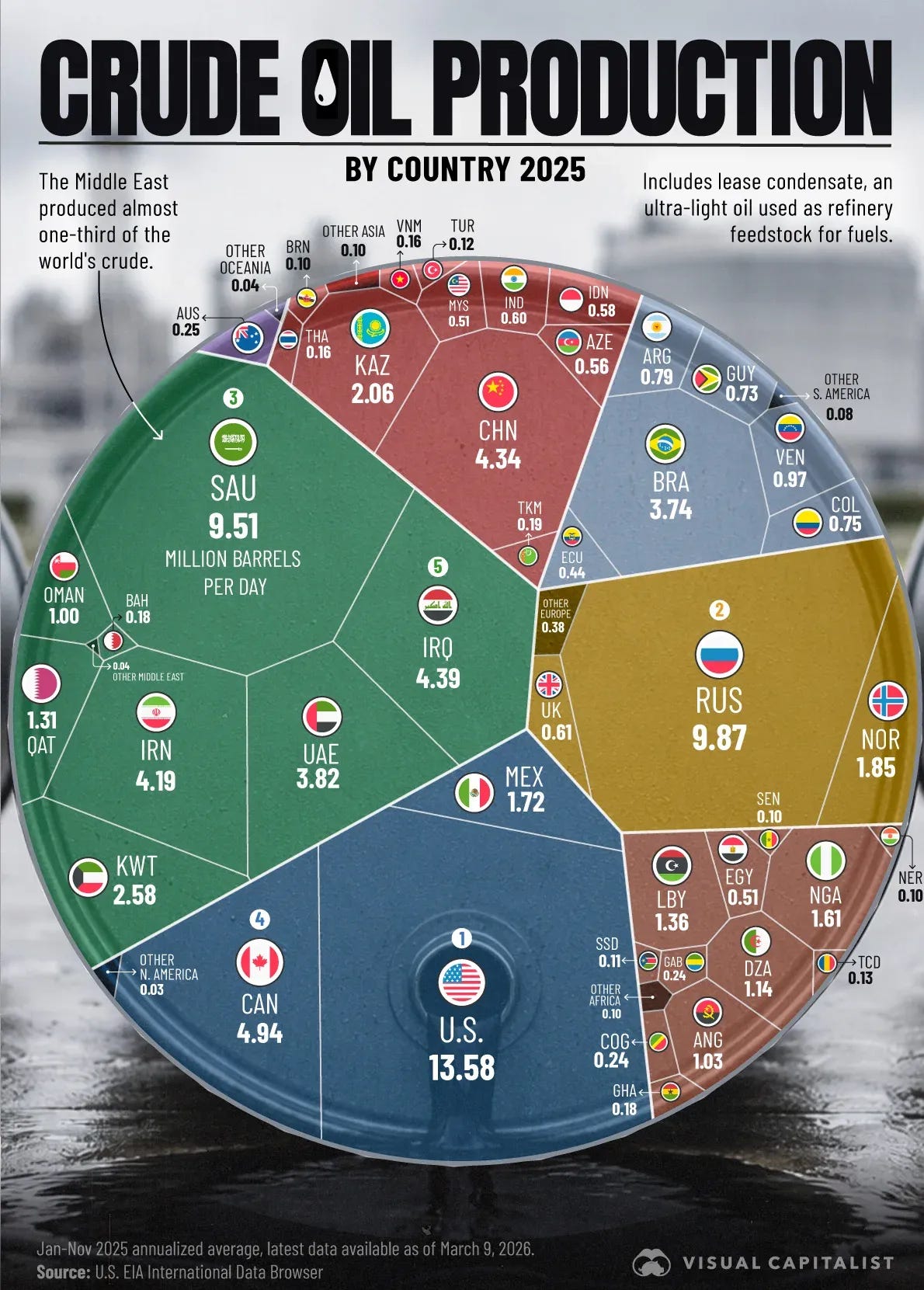
Climate campaigns in the US and Europe have mainly focused on shareholder resolutions, ESG mandates, divestment campaigns, securities disclosure rules, and courtroom judgments. The value of these tactics is mixed, and they operate under the assumption that companies are beholden to shareholders, the public, and regulators. None of that touches Aramco or the Iranian oil ministry. You can win every proxy fight at Western majors and only change a minority of the industry, while the majority sits with sovereign producers. And even those wins, which are fraught, do little for overall oil demand. Instead, they shift production from the US to elsewhere in the world, where environmental regulations are likely lower for production and transport.
The Cartel
OPEC is a legal cartel (and its expanded incarnation, OPEC+, which adds Russia and others) is the mechanism by which a subset of NOCs manages the price of oil.
OPEC works on spare capacity. The group gets together and hashes out what production a country could bring online but chooses to hold back. This is done to artificially restrict or increase supply to benefit the organization as a whole, at least in theory. Saudi Arabia is a heavyweight player, as the only member to have held meaningful spare capacity (about 1.5 to 2 million barrels per day). This makes it the swing producer, the one who can add or subtract barrels to nudge the global price. Everyone else mostly pumps as much as they can flat out. The cartel sets quotas, but the members cheat to varying degrees.
Two developments show OPEC’s power in global markets. First, US shale. When American production nearly doubled from 2010 to 2024, the US became a swing producer in its own right, and OPEC lost near-total control. Its 2014 attempt to crush shale by flooding the market failed; shale was too resilient. Second, the 2016 expansion into OPEC+, which added Russia, was OPEC’s adaptation to rebuild its pricing power by widening the coalition. Recently, the UAE announced it is leaving OPEC. This decision is largely driven by frustration over Saudi-led quotas and the UAE’s efforts to differentiate its economy away from a uniquely hydrocarbon-dominated model.
The reminder is currently parked in the Strait of Hormuz.
Despite its market sophistication, the oil and gas economy runs on physical geography. The Strait of Hormuz is the obvious example.
Since early March 2026, after US and Israeli strikes on Iran, the strait has been effectively closed. Iran declared it shut, mined the central channel, and attacked vessels attempting passage. Roughly 20 million barrels a day, about a fifth of global oil supply, normally transits it, along with a fifth of the world’s LNG. Bypass pipelines through Saudi Arabia and the UAE replace only a fraction. The IEA called it the largest supply disruption in oil market history, larger than the 1973 embargo. OPEC production has fallen more than 30% since the war began.
The NOCs that own the resource are trapped behind the chokepoint: Iraq, Kuwait, Qatar, and the UAE, with their barrels stranded. OPEC’s spare capacity, the safety net that caps prices, is mostly behind the closed strait. This means the one tool the system had to absorb a shock is the tool the shock disabled. The biggest beneficiaries, per a New York Times analysis, have been the United States and Russia, producers that don’t ship through the Strait of Hormuz. However, the biggest losers have been global consumers of not just oil and gas but also ammonia for fertilizer, aluminum, and countless other commodities that pass through the strait.
Fortunately, the global oil and gas system has dedicated resilience measures to mitigate large-scale supply disruptions. Strategic petroleum reserves and inventories (onshore and floating) have played key roles in preventing massive price hikes, but we have also seen meaningful demand destruction, especially in Asia. China may have saved the world from the worst impacts of the Strait closure. An irony, considering this administration’s treatment of China and the political fallout it has faced and could continue to face with the closure.
The war in Iran and subsequent closure of the Strait of Hormuz have been a reminder to the world that the flow of oil and gas isn’t a certainty. And the ability to influence that flow isn’t based uniquely on near-term market conditions but rather a mosaic of economic, geopolitical, and security decisions.
The Opaque and Messy Middle
There’s one more actor I would be remiss not to mention because they are largely unnoticed by the public and even among energy policy professionals. Oil and gas have to get from point A to point B, and that financial and sometimes physical journey is mediated by the traders.
A handful of mostly private firms- Vitol, Glencore, Trafigura, Mercuria, Gunvor- move a large share of the world’s physical oil. They don’t own much oil in the ground or refine most of what they handle. They are the connective tissue. Buy crude and gas where it’s cheap, ship it, finance cargoes, manage logistics, and profit from spreads and volatility. When the market is chaotic, as it is now, they do well because chaos creates price differences across time and space, and arbitrage is how they make money.
They wield real power with little public visibility. They’ve kept commodities flowing through sanctions, wars, and embargoes, sometimes in ways governments quietly relied on, sometimes in ways governments tried to stop. They have a parallel in the farming analogy, with dozens of commodity traders doing the same for agricultural goods.
I won’t try to do them justice here, because someone already has. If traders interest you (and they should), read The World for Sale by Javier Blas and Jack Farchy. It is the single best account of how these firms work and how much they shape the world, and it’ll do more to your understanding of the physical oil market than anything other I could point you to. And you’ll find out how the infamous Jamaican bobsled team overlaps with oil markets.
The money behind the molecules
Underneath all of it sits capital. Every barrel or mmtbu described in this series, every well, pipeline, FPSO, refinery, and LNG terminal exists because someone financed it. That financing decision is made years before the first barrel flows and remains locked in for decades afterward.
The real climate-relevant variable hasn’t been the resource (there’s plenty) or production (it responds to price), but the capital-allocation decision. A reserve is just a number until someone writes a multi-billion-dollar check to develop it. A deepwater project sanctioned today is expected to produce into the 2050s. A refinery built now amortizes for fifty years. The check-writing moment casts the longest shadow, which is why leverage points cluster around financing, banks, project lenders, insurers (who can make a project uninsurable and unbuildable), and producers’ internal capital discipline.
I noted in the exploration post that Western majors have been pulling back upstream spending while NOCs keep pouring money into capacity. Whether that’s good or bad for emissions depends entirely on who supplies the marginal barrel and how cleanly they produce it. One climate goal is for all oil and gas produced to have the lowest possible carbon intensity. The carbon intensity of production, transport, and usage varies greatly across companies, countries, and even within countries.
The high-leverage points:
1. Methane: Methane leakage is one of the highest-return climate interventions in the upstream sector. It is relatively cheap to fix, technically well-understood, and increasingly measurable from satellites. It’s the one place where a small effort meaningfully changes the climate math of the entire gas system.
2. Demand-side destruction via substitution: The series’ demand posts argued the transition runs through demand, not supply. EVs ending gasoline, heat pumps ending heating gas, renewables-plus-storage overtaking power-sector gas. China’s EV-driven flattening of its oil demand will do more to bend the curve than any supply-side campaign.
3. Capital, permitting, and insurance. The financing layer is where long-lived infrastructure gets locked in or not. This is double-edged: the same permitting and legal tools that slow a gas pipeline also slow a transmission line or a CO2 pipeline, so it cuts both ways, but it’s where decisions with the longest shadows get made. And if we believe low-carbon energy technology (solar, wind, batteries, heat pumps, etc.) are cheaper and better, they will win in the long run anyway.
Lower leverage points:
4. Supply-side restrictions: Blocking a specific Western pipeline or pressuring a specific Western major produces visible wins, but production tends to reappear elsewhere, often with a sovereign producer beyond the reach of further pressure and sometimes with a higher emissions intensity. Demand will be met regardless of who supplies it. This isn’t a reason to do nothing, but it’s a reason to be honest that reallocating production is not the same as reducing it, and to weigh the symbolic value of a win against its actual effect on atmospheric carbon. And the best way to reduce the supply of oil and gas is to develop and scale better alternatives.
Climate consequences for the whole series
1. The industry is a system: Power is distributed across NOCs (who own the resource), OPEC, traders (who move the molecules), financiers (who fund the infrastructure), and everyone consuming oil and gas-based products (demand). The investor-owned majors everyone pictures are the most visible and most pressurable part, but not the largest nor most important.
2. Most of the resource sits beyond Western pressure: Sovereign producers control the majority of production and reserves and don’t answer to shareholders, courts, or ESG mandates. Any strategy that only works on publicly traded companies addresses a minority of the system.
3. Security, cost, and geopolitics come before climate: The Hormuz closure is the live indication that physical chokepoints and political decisions, not just market forces, govern whether oil reaches buyers. Demand forecasts that assume smooth supply are betting on geography cooperating, and sometimes it doesn’t. The politics of the time center on affordability and the cost of living, and over and over again, people prefer a cold beer and a hot meal to climate action. It is very difficult to convince people that they should pay more for something that is “cleaner”, and for many things people use or consume, the cheapest production method is oil and gas.
4. Capital allocation casts the longest shadow: The decision to finance a project locks in production for decades. The decision to finance is an economic one, and the tools to change the economics run through cheaper alternatives.
5. Strive for better, not perfection: Global energy is dominated by oil and gas. This happened because they are cheap, abundant, and incredibly useful. If we want the future to be emission-free, we need to create policies, regulations, and politics to make emission-free energy cheap, abundant, and useful. This is, of course, demand-side destruction, but also methane regulation, carbon capture and storage, hydrogen, and plenty of oil- and gas-adjacent markets that will bring that low-emission future to reality. The creation of the energy economy as we know it today didn’t happen overnight, and neither will the transition.
Glossary
New terms introduced in this post (post 2-8 glossaries still apply):
Acronyms
NOC / IOC — National Oil Company (state-owned, e.g., Saudi Aramco) versus International Oil Company (investor-owned major, e.g., ExxonMobil). The central distinction of this post: NOCs own most of the resources and answer to states, not shareholders.
OPEC / OPEC+ — Organization of the Petroleum Exporting Countries, the cartel of major producing states; OPEC+ adds non-members, including Russia, formalized in 2016.
Terms
Cartel — A group of producers that coordinates output to affect price. OPEC is the world’s most consequential example.
Commodity trading house — A firm (Vitol, Glencore, Trafigura, Mercuria, Gunvor) that buys, ships, finances, and sells physical commodities, profiting on price differences across location, time, and quality. Privately held and lightly scrutinized.
Project finance — The financing structure for large infrastructure projects, where a project’s own future cash flows secure the loan. The point at which decades of production get locked in.
Spare capacity — Production that a country can bring online quickly but chooses not to. Saudi Arabia’s spare capacity is what makes it the swing producer; its depletion (as during the current Hormuz crisis) removes the market’s main shock absorber.
A swing producer is a supplier or group of suppliers that controls global deposits of a commodity and has large spare production capacity, enabling them to influence prices by adjusting output. Historically, Saudi Arabia has played this role in the oil market. According to Wikipedia, a swing producer has the ability to affect world market dynamics in this way.
Upstream, midstream, and downstream refer to the three stages of the oil and gas value chain: upstream involves exploration and production, midstream covers transportation and storage, and downstream includes refining and selling. The map on which the whole series was built.
I didn't realise that distinction between NOCS and IOCs exist. Can the NOCs work without the IOCs? Are they completely separate or are there other sticky ties...and if so, what are they and how easy are they to break.